The Price is Right: 8(a) Edition
On April 30, 2026, President Trump signed an executive order titled Promoting Efficiency, Accountability, and Performance in Federal Contracting, establishing fixed-price contracts as the "default and preferred method of procurement" across the executive branch. The order is the right policy at the right moment. It is also, in one significant respect, behind the curve: the federal government already runs a program built on precisely the discipline the EO is trying to spread, and has for more than fifty years. The 8(a) business development program operates with the fixed- price rigor the rest of government is now being told to adopt — and the data show it has been doing so consistently, across administrations, for at least the last eight fiscal years. The order requires written contracting officer justifications and agency-head approval for any non-fixed- price award above specified dollar thresholds, and directs every agency to renegotiate its ten largest non-fixed-price contracts within 90 days. What it does not yet acknowledge is that one corner of the federal acquisition system is already there.
The President deserves credit for naming the problem plainly. Cost-reimbursement contracting — particularly the $120 billion in consulting work the order singles out — has too often functioned as a slush mechanism for hours billed without measurable results, and the EO's insistence that profit be tied to performance is exactly the kind of taxpayer-first discipline federal procurement has needed for a generation. It is a serious effort to make the government buy the way any responsible enterprise buys: with a defined scope, a defined price, and a contractor on the hook to deliver.
What deserves equal recognition, though, is that the federal government already runs a program built on precisely this logic — and has for more than fifty years. The 8(a) business development program already operates with the fixed-price discipline the EO is trying to spread government- wide.
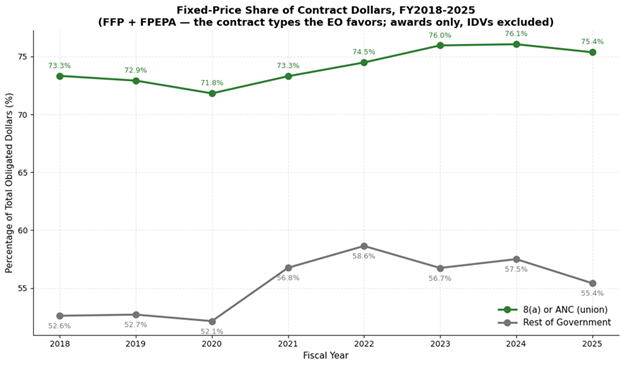
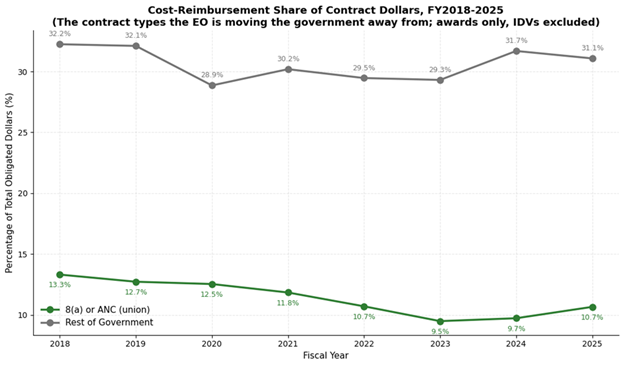
The data make the case better than rhetoric can. Across FY2018 through FY2025 — eight consecutive fiscal years, spanning two administrations and a pandemic — 8(a) and Alaska Native Corporation contractors obligated between 71.8% and 76.1% of their contract dollars under fixed- price terms, while the rest of the federal government managed only 52.1% to 58.6%. The gap is roughly 18 to 20 percentage points, every year, without exception. The mirror image holds on the cost-reimbursement side: 8(a)/ANC firms run between 9.5% and 13.3% cost-type, while the rest of government runs between 28.9% and 32.2% — roughly three times as much exposure to the open-ended billing structures the EO is moving away from.
These are structural differences, reflecting the efficiency and transparency of the 8(a) program.
When a contracting officer awards work through the 8(a) program, the taxpayer is more than 20% more likely to know the price before the work begins — and less than a third as likely to be on the hook for whatever the hours add up to.
That is exactly the discipline the EO calls for, and 8(a) firms have been delivering it for years.
President Trump's executive order is the right policy at the right moment, and it deserves the bipartisan support of anyone who takes seriously the obligation to spend public money the way a careful steward would. Fixed-price contracting forces honesty into the front end of every acquisition: requirements get defined, scope gets bounded, risk gets priced, and the contractor - not the taxpayer - bears the cost of poor execution. The President has named a real problem and prescribed the right medicine. If the Administration is looking for a model of how the rest of the federal contracting enterprise might look once the EO is fully implemented, it does not need to look far. It already exists.